POLITICS
"I think people show their ignorance when they say they want politicians to be honest. If honesty were suddenly introduced into politics, this country would fall apart. And, I think people know that deep down. They like their bull shit out front where they can get a good strong whiff of it! That's probably why they picked Bill Clinton over Bob Dole. Clinton was honest about his bullshit. He was up front. He came right out with it. Dole tried to hide it. 'I'm an honest man'." - George Carlin
The harsh realities of politics in the U.S. are shaped by three basic factors. There is the conventional wisdom possessed by the voters. Then there is the power and influence of the lobbyists representing the special interests. And most important, there is the level of inclination of the people to actively participate in the electoral system. The latter factor refers not only to simply taking the time to vote, but also making the effort to become fully apprised of the issues as well as the candidates. This chapter deals with threats to our survival contained in each of the three "factors". The conventional wisdom is always dangerous since it is generally outdated, and often positions voters to respond to appeals to quick or simple solutions to perceived problems aimed at dealing with the symptoms rather than recognizing and attacking the roots of the problems. The control over our electoral system exerted by special financial interests tends to make a mockery of democracy. And, of course, the percentage of voters actually bothering to vote is a national disgrace. We have the lowest rate of all the Western democracies. Considering this lack of effort made by Americans in choosing leaders as well as ballot initiatives, it should not be very surprising that so many of us tend to distrust our government. What is interesting is that most Americans blame the politicians rather than themselves. It seems that we have generally come to realize deep down, but perhaps not wish to fully acknowledge, that no politician can hope to gain office or affect the legislative process without altering, misrepresenting, or playing games with the truth. Nor can he expect success without offering concessions to the "special interests" whose agendas may not coincide with the general welfare of the public. And so long as we refuse to make the sacrifices required to make democracy work, "monied interests will determine our elections. At present, most seem content enough to condone these conditions, perhaps oblivious to the dead end that exists down the line. This writing is dedicated to exposing the disasterous consequences of that dead end, and to finding the means to alter the "present realities" before we reach the end.
     It might be said, politics is where it’s at!  Whether a society be a
democracy, a dictatorship, an oligarchy, a kingdom, or whatever, it is the
willingness of its people to become involved in the struggle for power that
counts.

     The Nov.'94 national election in the U.S. gave the Republican Party
control of Congress, and seated Newt Gingrich as House Speaker- making him
the second most powerful man in the country.  The media, the Republican
Party, and Gingrich, himself, heralded this outcome as an overwhelming
landslide, and mandate for Republican Party policy.

     However, a closer inspection of reality here, would reveal that only
one out of twelve of the voting-age public actually voted for the
republicans!  Yes, it could only happen in America!  One twelfth of the
people controlled the the government.  The math behind this logic is that
only half of those eligible to vote bothered to register.  In the election,
only 37% of those registered bothered to go to the polls.  That adds up to
about one sixth of the people voting.  51%, or roughly half of those
voting, voted Republican.  One half of one sixth equals one twelfth!

     Most Americans seem at least passively aware of the many warnings and
admonitions handed down to us by our forefathers ("eternal vigilance is the
price of freedom" etc.)  Few would doubt these to be true.  Yet, most seem
to find distrust, disgust, or even simple inconvenience, an adequate excuse
for failure to participate in this "vigilance", or the electoral process.

     As we should know, less than half the eligible voters generally show
up for an election.  As well, surveys have shown that a majority of the
voters in the United States are unable to tell the names of the two U.S.
Senators who represent them.  Apparently, the same hypocrisy here, rings
true as when the greedy rich man or the conquering warrior profess an avid
devotion to the teachings of Jesus.  Americans praise democracy, but fail
to do the homework necessary to make it work.  We love to "talk the talk",
but tend to stumble when it comes to "walking the walk".  In the simple
words of Walter Cronkite, "Education levels are so low that the public does
not have the capability of making an informed judgement..."(LA Times, Jan.
21, '96).

     Of course, it doesn’t take a Ph.D. in logic to deduce that any civic
problems, or malaise attributed to unscrupulous politicians, might have
been avoided had those politicians not been able to take advantage of an
uninformed and apathetic electorate.  Even well-intentioned politicians
openly admit that it’s essential for them to consort with "special
interests" in order to obtain the funds required to get elected.  Media
sound-bites and billboards seem far more effective than expecting the
voters to attend meetings where the issues are discussed with the
candidates. It seems apparent that the value of political education is not
one fostered and nurtured by the institutions we have created to aid our
society-institutions which do, however, help shape and mold our values.

     In spite of the fact that financial interests do affect, to some
extent, the information we receive from the media, sources are nevertheless
available for those inclined to make the effort to obtain political
enlightenment.  Cable TV's C-SPAN covers "gavel to gavel" daily business of
both houses of Congress.  This is repeated during evening and nighttime
hours.  The burgeoning computer network offers growing opportunities for
live forums and discussion.  Newspapers and mainstream publications such as
"Time" and "Newsweek" are often useful if one is adept at "reading between
the lines".  However, more in- depth information and analysis is available
through private subscriber periodicals less dependent on advertisements
such as "The Nation", which incidentally provides in it's Aug. 28 '95 issue
an excellent account of political chicanery endemic in our system.  It is
worth relating here.

     "Conservatives in the House recently voted to cut $9 billion out of
labor, education and health funding.  When Congress reconvenes, it plans to
vote the Pentagon about $7 billion more than it asked for.

     The implicit trade-offs are obscene: $1 billion is to be taken from
the poorest school districts in America, cuts of about $5,000 per urban
classroom.  That "saving" -- plus throwing 50,000 kids out of Head Start
next year -- will about cover the $1.4 billion Congress plans to spend on a
boat the Navy did not ask for, to be built in Mississippi, home of
Republican Senator Trent Lott, who is on the ship-building subcommittee.
Unrequested military construction projects in appropriators' districts will
receive $500 million; $493 million will be spent on B-2 bombers that can't
tell a cloud from a mountain, and that the Air Force doesn't want.
Together, that is about what will be saved by ending the summer jobs
program, putting 600,000 teenagers on the street.  The 1 billion saved by
cutting home heating subsidies to the elderly will pay just under half next
year's cost of developing the F-22 fighter, which the General Accounting
Office argues should be put off until the next century.

     The Republican budget resolution contains plans to cut education,
training, housing and environmental programs in fiscal '97 while giving the
Pentagon $14 billion more than it wants."

     The foregoing provides an excellent example of the way our system
functions, or more appropriately malfuntions-this ugly combination of the
ill-informed, apathetic voter and the power-hungry pols pillaging the
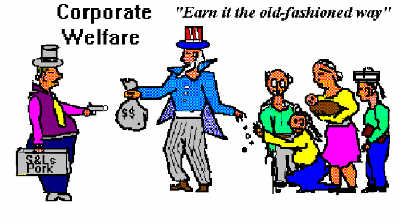
helpless and the needy.  It remains grotesquely ironic that they will, in
their own minds, generalize, and characterize all welfare recipients as
con-artists responsible for societies' ills, while at the same time ignore
the huge chunk of our budget that goes to what consumer advocate Ralph
Nader terms "aid to dependent corporations".  "By some estimates, the
government funnels up to $75 billion a year to business, enough to account
for almost half the federal deficit."(Time Mag. Mar. 25, '96)

     One graphic example of what Nader refers to may be uncovered on page
A27 in the Sept. 7,'95 issue of the LA Times.  The "Times" quotes Interior
Sec. Bruce Babbitt.  "You might reasonably ask, how can a public official
give away a billion dollars without going to jail?  The fact is I have no
choice.  This corporate welfare has been going on nonstop for 124 years and
the U.S. Congress is the only place that can bring a halt to this."  What
Babbitt is referring to is mining companies taking advantage of an
antiquated law conceived in 1872 to buy priceless public land for $2.50 an
acre, the same fee charged in 1872.  In Babbitt's words, "This is a tawdry
process", and a "flagrant abuse of the public interest".  In 1994 Babbitt
signed over $10 billion in gold to a Canadian firm for about $10,000.  The
question which neither Babbitt  nor the L.A.Times seemed able, or perhaps
even interested in answering, was why Congress, pledged to an effort at
balancing the budget, stood steadfastly by, refusing to change the
antiquated law which enabled this theft - or should we call it welfare?


     Of course, by one reckoning, the answer is obvious.  The thieves know
they can get away with it!  The public is not watching.  It sits by
obliviously, enshrouded by and basking in the many escapisms conveniently
provided by corporate America.  The real mystery, nevertheless remains:
must it always be this way!

     Thus, those who loudly and vehemently complain of the decay, the crime
and violence rampant in society, do by their own actions, or abdication of
responsibility, precipitate the carnage.  Much as we seldom notice how much
more is lost by banks from "white-collar crime than from armed robbery, so
do we close our eyes to losses incurred by the needy, the elderly, the
children, the handicapped, etc. -all taken by legislative misappropriation.
The actual deaths resultant here are not and can not be counted.  Yet we
must know malnutrition, ignorance, and lack of health care do kill!  Who's
to say that these deaths do not exceed those attributed to violent crime.
We just don't call it murder.
     Another case in point, although, obviously they are endless.  C-SPAN
covered an address on the Senate floor in July, '95 by Sen.Bryan Dorgan
concerning a complicity involving House Speaker Newt Gingrich and the Line
Item Veto.  The Line Item Veto (LIV) has for years been recognized by
Congressional reformers, including Sen. Dorgan, as a measure vitally
necessary to cut much wasteful governmental spending.  It's enactment would
enable the President to cut riders involving "pork" from Bills before
signing them.

     Pork, of course, is the term applied when funding is voted for
generally unnecessary projects, primarily to aid constituents in a
particular legislator's district.  It's basically, "I'll vote for yours, if
you'll vote for mine."

     As Sen. Dorgan reports, Gingrich had previously made an issue about
how Republicans, having gained power in Congress, were finally going to do
something about enacting the LIV, since it was clearly a giant step toward
implementing their Party's resolve to cut waste and balance the budget.

   In Gingrich's words,"We have a bipartisan majority that is going to vote
for the Line Item Veto.  For those who think that this city has to always
break down into partisanship; you have a Republican majority giving to a
Democratic President this year, without any gimmicks, an increased power
over spending which we think is an important step for America."

     By March of '95 both Houses of Congress had approved a bill enacting
the LIV.  All that remained was the traditional formality required for
passage of all bills - the meeting of the inter-House conference to
finalize the bill in preparation for the President's signature.  As Sen.
Dorgan notes by mid-summer the Senate conferees were duly appointed and
ready to meet. But, lo and behold, where were the five House appointees now
that the time was ripe!  They were supposed to have been picked by the
Speaker; but it now appeared that the noble Gingrich had somehow changed
his tune!  "My sense is that we may not get to it this year".  Gingrich
lamented that he just didn't have enough time to appoint the five conferees
right now.   Senator Dorgan, nevertheless, notes that Gingrich did find
time that year to write two books and go off around the country on a book
publicizing and book signing tour.

     Perhaps more honest and to the point, was the statement of Bob
Livingston, Republican Chairman of the House Appropriations Committee.  "We
may not want to give the Line Item Veto to this President right at the
outset".  Translation: Let's wait for a Republican President.  He'll
protect our pork!

     And as it turns out, amazingly enough, the Washington Post reports in
Aug. that bills totaling $200,000,000 in pork unrequested by the Pentagon
are earmarked for Speaker Newt Gingrich's home state, Lockheed. Oops,
Georga. But wait!  Not all is lost.  Newt could be heard in Dallas at Ross
Perot's "Big Bash" talkathon conference for patriotic politicians in August
saying "We Republicans can't wait to get back to Congress and proceed with
our quest to balance the budget."

     Now, the voters in Gingrich"s district may smile, and say, "Harrah, we
got what we want."  But, of course, what they don't realize, is that when
it happens all over the country, we are all the losers!  Is it really
futile to hope that we voters will ever  wise up, rise up and demand
reforms such as     the LIV?
The vital question is, of course, is this endemic
voter apathy simply attributable to that elusive
concept, "human nature", or is the situation
correctable if certain alterations are made in the
"system"?  The answer has to be at least a
qualified "yes", because we have in the past made
changes in the "system".  The "system", comprising
all those human institutions we have devised to
help us live our lives, does, of course, exert
enormous control over our lives.

     Our values are affected by the "system".  Voter apathy has to be one
of the results of the "system".  It is not some inbred genetic factor that
leads to general public apathy.  Sociologists and anthropologists, the
scientists who study societal traits, generally agree that human values are
shaped by the cultural institutions surrounding them.  The fact that
individuals in the same society do have varying values is, of course, due
to each individual having varying degrees of contact with those
institutions in the society in which he lives, as well as a certain amount
of input which does derive from genetic factors.  The effect of the
established institutions in a society is to produce a similarity, not
necessarily a unanimity of values.

     For any democratic, or republican system to be of use, the people need
to provide the input.  The importance of political education must be
recognized.  The conscience, the will, the desire, the dedication, to
participate in the political process must be instilled in the populace.  As
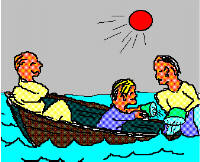
alluded previously, with the threat posed by expanding technology, humans,
like men bailing water in a sinking boat, must overcome selfishness and
learn to work for the common good.  Fifty percent of the public voting, and
less than fifty percent of those voters really knowing who and what they
are voting for should be a significant warning sign.

     Looking for ways to improve the political system by altering the
rules, the laws and the procedures (term limits, campaign contribution
limitations, electoral college, balloting, etc.) may be of minimal value
but generally misses the boat.  Those societal institutions which shape the
desire to participate must be examined.  How might they have helped
contribute to the electoral malaise existing today?  And, what might be
done to change the course?

     The answer, of course, lies in the examination of that multitude of
interlocking institutions which have evolved in our society.  American
institutions in the field of economics are next in line for scrutiny!