Catlin was born in Wilkes Barre, Pennsylvania. Indians had a strong influence on Catlin's life because his mother had once been captured by them; they were his subject matter. In 1831 Catlin set off for St. Louis, became friends with General William Clark and ventured up the Platte River. Later he traveled up the Missouri to Ft. Union on a steamboat and returned by canoe to sketch places he had missed. The paintings from these trips form a magnificent exhibit and were presented to Congress for sale in 1838, only to be rejected. Catlin took his works to Europe where they were displayed in the Lourve and elsewhere and admission was charged to see them. They were then hung at Sharkys casino in northern Nevada until it closed in 1999.
|
|
 Viewer |
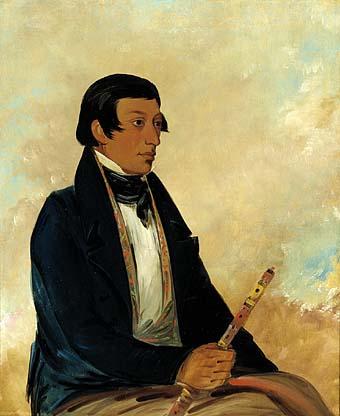
Kee-món-saw, Little Chief, a Chief, 1830 Kaskaskia/Miami oil 29 x 24 in. Smithsonian American Art Museum, Gift of Mrs. Joseph Harrison, Jr. Little Chief, a Kaskaskia, was one of Catlin's first subjects in the West. Little Chief was not, however, a member of a western tribe, as his dark suit, white shirt, and cravat suggest. Well before Congress passed the Indian Removal Act in 1830, the government had entered the business of removing eastern tribes from their ancestral lands to reservations west of the Mississippi. The Kaskaskia had already ceded their land in Illinois and were living south of Fort Leavenworth, Kansas, when Catlin made his first western tour in 1830. Catlin described Little Chief as "half-civilized, and, I should think, half-breed," the result of more than a century of contact between the Kaskaskia and European traders. |
| Choctaw | Seminole | Assinneboine Warrior | Sioux | Clark | Kaskaskia | Missouri River |
| Renowned Artists Gallery index (61 galleries)
Other Parts of the Permanent Gallery | ||
| Digital Color Winners 2004 and 2005
Digital Color Winners 2002 and 2003 Digital Color Winners 1999, 2000 and 2001 |
Watercolor Painters
Oil Painters Pen and Pencil Artists |
Photographers
Sculptors Authors |